From Sunderland to South Wales: Casting the Suddick mallards in bronze

In my recent press release about The Suddick Flypast, I mentioned that I travelled to South Wales to cast the bronze ducks by hand, using the lost-wax approach. This post is the “under the bonnet” version — the practical reality of turning a clay model into bronze, and why that experience matters to the next stage of my practice.
Before the journey even begins, bronze casting asks you to think differently. Steel fabrication lets you build through joining and layering. Bronze asks for commitment: the form has to be resolved before it disappears. You’re not just making an object — you’re planning a route for molten metal to flow, feed, and cool.
Arriving at New British Art
I travelled down from Sunderland to work at New British Art in Wales — an artist-led, rural learning environment with a strong sculptural focus, operating from a farm near Carmarthen and supporting peer-to-peer learning alongside experienced guidance. That setting matters. There’s a seriousness to the work, but also a sense of shared purpose: everyone is there to learn by doing, and the process rewards attention.

Stage 1: From clay to mould
The ducks began as clay models. In the press release I spoke about building the piece to connect with Southwick’s place and story — river, windmill, oak, poppies, and the flying mallards as a nod to waterside identity. The clay work is where gesture lives. If the wing angle is wrong by a few degrees, the whole thing goes stiff. If the surface is too perfect, it loses its honesty.

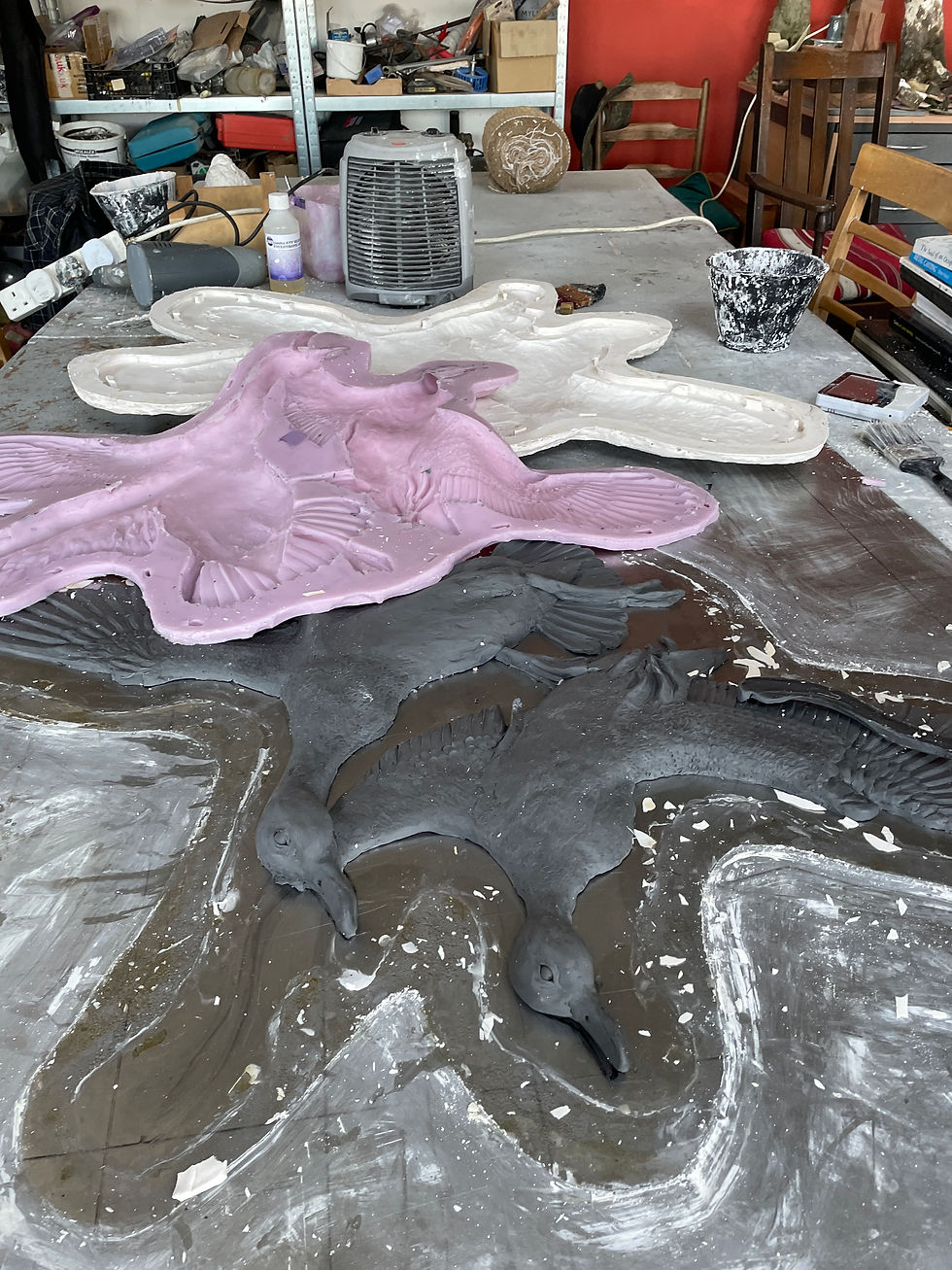
Once the clay model is resolved, the next step is mould-making. A mould captures the clay form so you can reproduce it in wax. This is where you start thinking like a foundry: part lines, undercuts, release, and how you’ll get a clean wax out without distorting the shape.
Stage 2: Wax — the “working original”
The wax stage is deceptively important. Wax isn’t just a copy; it’s the version you actually cast. Wax needs refining: seam lines removed, details reasserted, and surfaces prepared so that what ends up in bronze still carries the marks you intended.

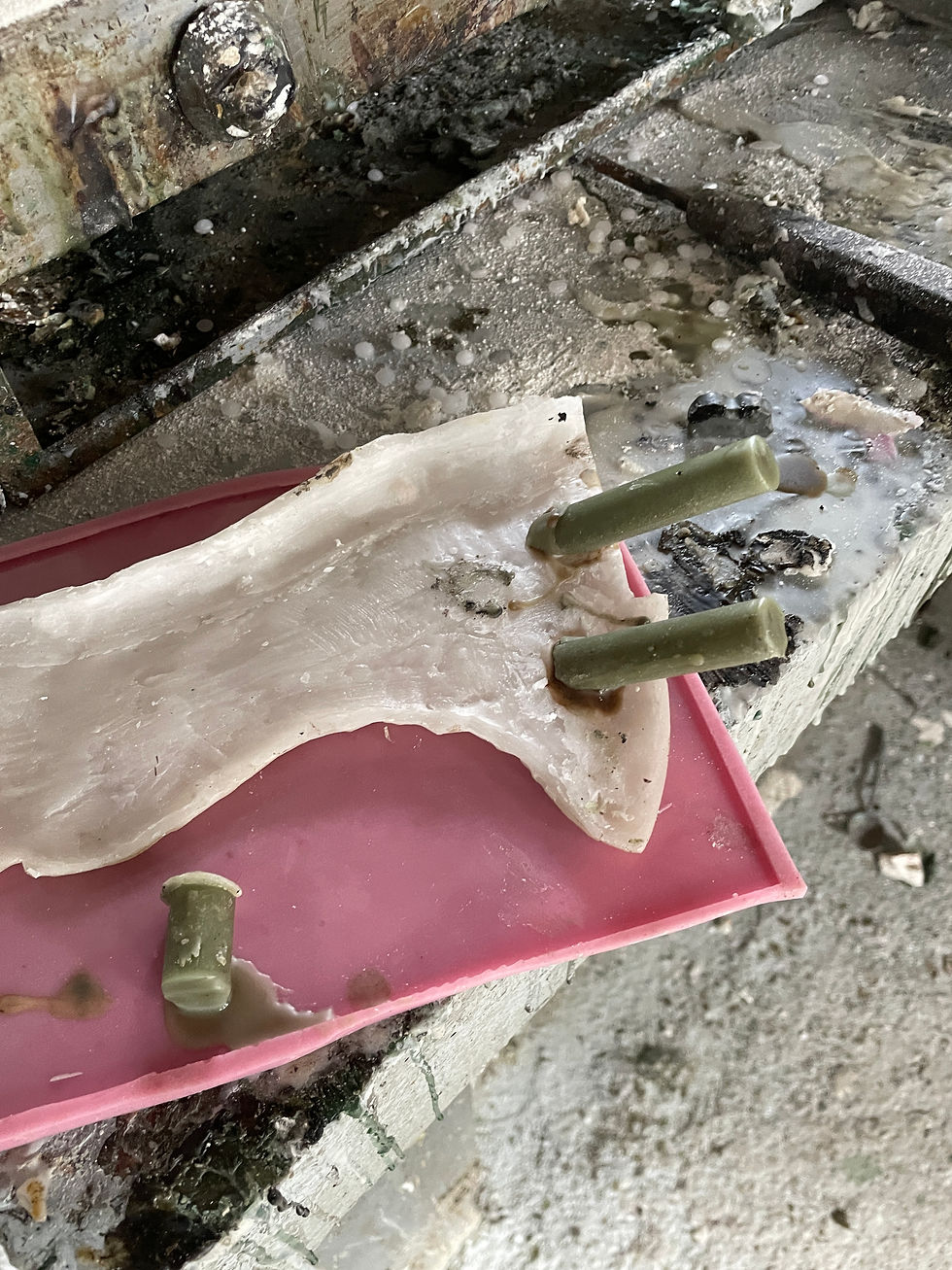
Then comes spruing (adding wax channels). These channels become the routes for bronze to flow in and for air and gases to escape. In simple terms: you’re designing a plumbing system for a moment of controlled violence — metal moving fast, then cooling and shrinking.
Stage 3: Ceramic shell — building the mould that can take fire
For the mallards, we used ceramic shell. In the press release I described it simply: wax model, ceramic shell around it, wax melted out, bronze poured in. The lived reality is hours of repetition and care.
Ceramic shell is built in layers. You dip the wax assembly into slurry, then apply a graded sand/stucco, then dry it fully. You repeat that cycle until the shell is strong enough to take the pour. Drying time isn’t a side note — it’s the difference between a shell that holds and a shell that cracks.
Each layer is a quiet commitment: you’re wrapping your wax in the future mould, knowing that the wax will be sacrificed.

Stage 4: Burn-out — losing the wax to keep the form
Once the shell is fully cured, it goes into the kiln. Heat does two jobs: it melts the wax out and it fires the shell so it can withstand molten bronze. This is the point where “lost wax” becomes real. The original wax is gone. What’s left is a negative space, waiting.
Burn-out is also where safety and discipline become non-negotiable. Temperature, timing, handling hot shells, ventilation — it’s a system. It’s one reason I’m now pursuing more structured research and development: if I am going to bring elements of this process in-house, I need the strongest possible understanding of safe practice and reliable process control.
Stage 5: The pour — bronze as material truth
The pour is the moment everyone imagines, but it’s only possible because of all the quiet work beforehand. Bronze is melted, brought to temperature, and poured into the hot shell. It’s fast, focused, and physical — and then, suddenly, it’s waiting. Cooling is part of the casting. You can’t rush it without consequences.
When the shells were cracked open, the first reveal felt like a small miracle: the forms held, the surfaces carried the detail, and the ducks emerged as bronze — exactly the reason I chose this material for the flying elements of The Suddick Flypast.

Stage 6: Chasing, finishing, and integration
After devesting comes chasing: cutting sprues, grinding, refining seams, restoring texture, and bringing the bronze to the level where it belongs next to fabricated steel. The final work is never just “bronze” or “steel” — it’s the conversation between them.
For The Suddick Flypast, the bronze ducks add contrast and presence within a layered steel composition designed to invite people closer. The bronze carries light differently. It holds touch differently. It changes how the whole piece is read.

This experience confirmed something I already suspected: the future of my sculptural practice sits in the overlap between heritage process and contemporary expression. Bronze casting is an ancient method, but it’s not nostalgic. It’s demanding, technical, and alive — and it belongs in the same world as Sunderland’s industrial skill base.
Travelling to Wales to cast the mallards was both a practical solution and a turning point. It showed me what’s possible — and what I need to learn properly — as I work towards bringing foundry capability into my own practice in a safe, staged, professional way.


Comments